Tuesday, November 2, 2010

One Tough Dog

Another recent event...
Last week, we had a young pit bull mix (we’ll call him Bullseye) come in with what we suspected were gunshot wounds in the hip and the chest. He was somewhat depressed, weak, and had lost an undeterminable amount of blood. Lungs sounded OK, so we kept him for observation overnight. The situation dictated that we not do x-rays at that time.  He was a little better the next morning on meds, so we sent him home. We asked the owner to call us if there was any more trouble, or if his recovery wasn’t steady.

You may be wondering, why not pull the bullet out?

We see a lot of animals that have bullets, airgun pellets, BB’s and lead shot from shotguns in them that the owners never knew about. It’s what we call an “incidental finding” on an x-ray: it’s there, but it’s not causing any trouble where it is because the body has usually walled it off with scar tissue. We’ll often be looking at a broken toe or an enlarged heart on an x-ray, and then have to show the owner the extra metal that their animal is carrying around. There’s normally the potential for doing more harm than good when you go after the metal, so leaving the bullets in place when they’re not a medical issue is pretty standard in animals. 

Back to the dog-
Four days later, the owner brought Bullseye back late in the afternoon for new swelling on the point of his chest about the size of a fist. Dr. Fraser opened it up, and emptied out some bloody fluid. Then she checked inside the wound with a vascular clamp and ran into something hard attached to shredded muscle in an area that was supposed to be all soft tissue. Bullseye was stable and in good spirits, so we waited to do the exploratory surgery until the next day when we would have more time to do it properly.  Anesthesia, x-ray, surgery, and recovery all take time and we prefer to have animals wake up early in the day so we can watch them closely.  So Dr. Fraser patched him up, medicated him for pain, and housed him in a quiet place to rest.

This occurred on my afternoon off, so Dr. Fraser sent me an email describing what she found (the late night email is a pretty common occurrence between doctors at Branchville). I was scratching my head after she described things… neither one of us was really sure about what was going on, but having hard things attached to muscle usually means a piece has broken off a bone.  Not good. Given the direction we thought the bullet had traveled, it was possible that it would be ribs, shoulder blade, or the top part of the humerus (the upper arm bone). I took a little solace in the fact that this dog was still –amazingly- walking around with barely a limp. It couldn’t be too bad, right?

Bright and early, a tech and I got Bullseye sedated and took an x-ray of his chest:


As you can see, there were two metal objects in the front of the chest cavity. The one that looks like a mushroom is the expanded lead core of a hollowpoint .45 bullet. The curly looking one is a side view of the bullet’s copper jacket which peeled away after traveling through the heavy muscles and tissues of the chest wall.

Most hollowpoint pistol ammunition is composed of a cup of metal that touches the barrel, and a core of softer but denser metal that expands on impact with a target. This bullet had simply split into its component pieces, as many handgun bullets do at some point after impact. We went in and removed the bullet pieces - this situation was unusual in that they couldn’t stay where they were.

Here’s what they looked like when we got them cleaned up:


There is a dent in the lead core where it skipped off the humerus and chipped a small piece of bone away, but that damage is pretty minimal.

About 30 minutes after we took the bullet out, Bullseye was walking around. He left that afternoon and has been doing well for the last week.

For all the CSI / Law & Order / Bones fans out there, here’s the technical breakdown of the bullet path and dynamics inside Bullseye: The entry wound was on the left chest wall just behind the point of the elbow traveling slightly downward. The bullet traveled forward under the skin, beneath the shoulder blade, deflected off the head of the humerus, and passed forward across the top of the sternum through the pectoral muscles. Bullet fragments came to rest in the pectoral muscles on the right side of the chest- the bullet crossed the midline of the body. The chest cavity was undamaged.

Total length of the bullet path was 9 inches. The bullet began at .45 inches in diameter, and the expansion of the bullet left it at .70 inches in diameter when it reached the end of its travel. The separated jacket is intact, but sheared into 8 roughly even “petals”.  Recovered weight was 181.1 grains. If the bullet weight started out at 230 grains, then retained weight was about 79%.

Through an incredible set of circumstances, this bullet went from one side of the dog to the other and never hit a critical structure. He was always able to walk. During the 5 days that the bullet was in him, he was never in immediate danger.

Even so, law enforcement data shows that 80-90% of humans hit with a similar handgun round either don’t make it or are too incapacitated to continue fighting (this data is usually compiled from reports of people who are in gunfights with police).

I say all of that to say this:  Bullseye is one tough dog.

Sunday, October 24, 2010

How to Rob an Ostrich Nest

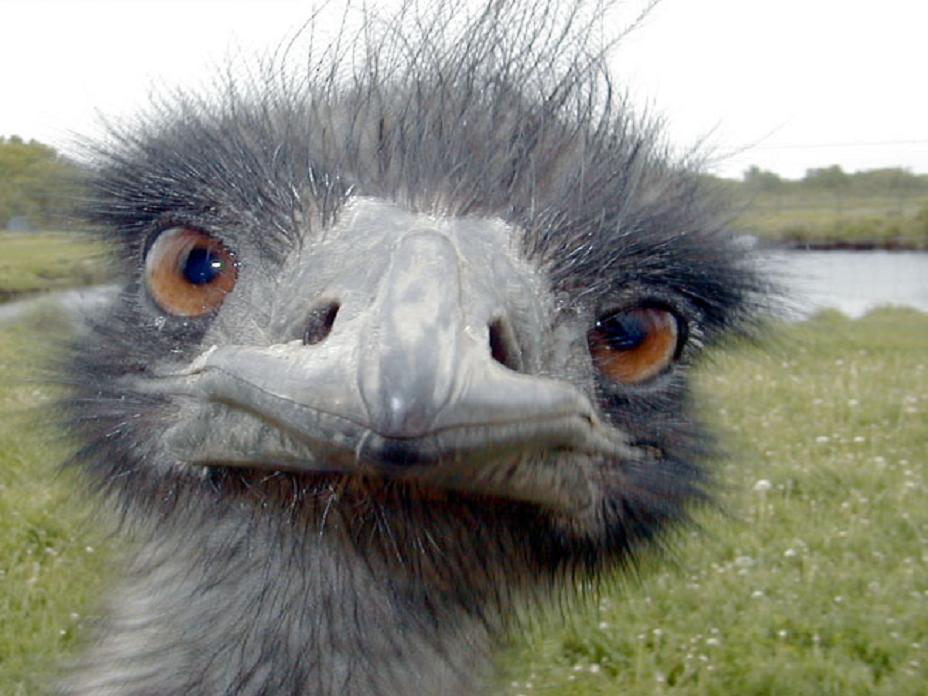
the ugly, yet lovable emu


When I was still in my first couple of years of veterinary school, I was lucky enough to pick up the strangest part-time job I have ever had. At the time, Auburn had a research unit for flightless birds to explore their commercial potential. The three types of flightless birds that they did the majority of the work with were ostriches, emus, and rheas. My co-workers and I were responsible for feeding the birds and collecting eggs to hatch out for a research project that was underway.


If you’ve never seen them before, emus are gentle and curious, a little skittish, and not terribly intelligent. I spent more time with these guys than any of the others, and thought that they were pretty neat. A couple of them were close to 6 feet tall. It’s odd to be around a bird that can look you in the eye while standing on flat ground. Their eggs are a deep jade green and weigh about a pound each.  They lay the eggs directly on the ground with no nest to speak of.  They will frequently try to hide their eggs by draping a strand or two of grass over the egg...  not much cover for an egg the size of a football. As I said earlier, they are not too bright.  The chicks are striped like zebras when they are first hatched.  Emus are fast; much faster than a vet student.  I once clocked an emu at 25 miles per hour when it was running beside my car, but I’m told that they can run faster. They can also jump over six feet into the air. I'm 6 foot 2, and I had one jump over my head one day when I was trying to catch it to draw blood.  I really liked working with these guys.

Ostriches and rheas are wired differently. 

Rheas are, essentially, miniature ostriches. They’re a little shorter and stockier than an emu. They also have the attitude of a rabid mongoose.  My understanding is that they are still captured for meat today in South America. Originally, this was done with bolas- a thrown device made out of ropes with two stones on either end intended to wrap around legs and trip the victim. It seems to me that you'd have to get pretty close to them to do that. As far as I’m concerned, if that was the only option to catch them, I’d consider moving out of rhea country or becoming a vegetarian.

Rhea males are particularly nasty.  At Auburn, there was one that would charge you like a bull every time you came into the rhea enclosure during breeding season. At feeding time, standard procedure was to take two buckets into the enclosure.  One bucket was full of feed for the more peaceable denizens of the pasture, and the other bucket was for him to plow into repeatedly when he came after you.  He would spread his wings out to the side (he looked about three times bigger when he did this), slam into the bucket, bounce off, and come back for more.  He was relentless.  He was also more intelligent than the average emu, which made him a little more unpredictable.

I wasn’t there for this incident, but I wish I had been. This is the way it was told to me:

 One of my classmates was trying to fix a malfunctioning watering trough in the rhea enclosure one night when she was ambushed by the dominant male rhea. She didn’t have time to get a bucket from the gate area to distract him before he would have plowed into her. Time for Plan B.
 She whipped out her keychain mace and blasted him at a range of about 2 feet (just in time to avoid being hurt- this guy was bad news). The rhea ran away and apparently never bothered her again while she was taking care of things.  Can’t say that I blame him.

Rheas can be scary enough, but the most serious of the challengers in the flightless bird gladiatorial arena was the ostrich.


The professors in charge of this unit gave a pretty direct safety lecture. It went like this: “Ostriches are not smart. But they kill lions in Africa, so don’t be taking any chances with them.” We didn’t have to be told twice.

I clocked an ostrich with my car just for fun, too. The enclosure that the ostriches were in had an eight foot fence and was pretty long. I saw the male at one end of it one day, and before he ran out of room running alongside my Accord, he had reached about 30 mph. With a little more space, I bet he could have topped 35 mph. When you think about it, something that has 4 inch talons, can run 30 miles per hour, weighs 250 lbs, and believes that the sun goes down and comes back up every time it blinks is not something you want to be stealing eggs from, but that was our job.

This was the way egg gathering worked: First, one person annoyed the ostriches into coming after them on the outside of the fence. While the birds attacked the fence trying to get to the decoy, another person quietly slipped into the enclosure and snagged the ostrich eggs. The eggs weighed about 3 pounds or so.  Then the egg thief would tuck it under their arm like a running back runs with a football and sprint to get out the gate before the ostriches noticed them.  Here’s a play-by-play from when of one of my buddies and I retrieved eggs one day. In the interest of anonymity, we’ll call this buddy Brian.

We checked the ostrich enclosure that afternoon, and found that the hen was nesting. Ostriches don’t nest the way other birds do- it’s more like they dig a shallow hole in the ground and sit on it.  Sizing up the situation, Brian and I got together and worked up a plan. I was to be the equivalent of a rodeo clown and get the attention of the adults, and he was going to sneak in and get the eggs.  Brian hid around a corner, and I started a commotion, jumping up and down and hooting just outside the fence. The male ostrich came at the fence immediately and started to kick at it… Hard.  One of the disconcerting things is that the metal fence flexed every time they kicked it, so it looked like the wire of the fence was getting stretched and bowed with each impact.  It took another 30 or 45 seconds for the female to get off the nest and come toward me.  When she stood up, I saw that she was indeed on an egg.


“Go ahead, Brian! There’s one egg!” I yelled.  Brian slipped into the enclosure behind the birds and moved as fast as he could without making noise.  He snagged the egg and tucked the trophy under his arm.  Just as he took his second step back away from the nest, the female heard him, turned away from the commotion I was making, and locked in on him.  I yelled a warning to Brian.  He picked up speed. The thought of an angry 250 lb. bird bearing down on you from behind will have this effect.  He was up to a full sprint in an instant. I wish I could have driven my car beside Brian to see how fast HE was going.


At this point, I was still trying to keep the attention of the male, who had just turned to see where the hen had gone.  But my antics were not enough... Now, both of the ostriches were onto Brian.  The big male, using all the reasoning power available to him,  decided to ignore me and go after the egg thief.  Brian’s burst of speed got him back to the gate.  He sped through and whirled around to slam the gate shut with a couple of yards to spare between him and the female, who had been gaining ground on him, with the male just behind.  To say that I was impressed by his display of athleticism would be an understatement. The man was inspired.


So….Anybody want to be an ostrich farmer?

-RAB

Tuesday, October 19, 2010

Current Events & Weird Stuff

Current events- An odd couple of weeks: 
 
Seeing things that are a little outside the norm keeps life interesting around the clinic. This week has been a little more unusual than most… so far, here are the oddballs for the first part of October: 
 
1.     A dog that had been in a fight with a beaver. It’s the first time I’ve ever seen something like that. Apparently, a beaver is a worthy adversary. If you’re thinking about picking a fight with a beaver…. You may want to think again. This dog was chewed up from one end to the other, but was doing well at home as of this morning. 
2.     A cat that came in for sneezing. It turned out to have a 4.5 inch long piece of grass stuck in its nose- we took a picture on top of a piece of 4X4 gauze. Here it is:  
This supposedly happens a lot, but I’ve only seen it a few times.  It had about ¼ inch of the blade sticking out of one nostril, which means that the other 4.25 inches was up the nostril, into the sinuses. It either wrapped around in there, or was actually going down the back of the throat. 
3.     Another C-section on a Sunday afternoon- smaller litter this time.  We called in five people from the clinic crew to be sure that there were enough folks on hand for this one. You never know how many puppies you may find once you get going.  For this c-section, we delivered 6 puppies (5 girls, 1 boy); all were doing well when we called the owners to check in on them the next day.  The puppies have already been named: Betty, Savannah, Wilma, Pebbles, Bubbles, and Harley.  You can see a picture of them at http://www.bulldogsofalabama.com/Puppy_Photos.html.
4.     Dr. Fraser diagnosed a cat with a pair of bladder stones that looked like two halves of a quail egg when she pulled it out during surgery. I’ve been collecting bladder stones since I was a kid working in a clinic, so I was pretty fired up about this one. I’ve got some pretty neat stones. It may be the only collection of its kind in St. Clair County.  My favorite one is about the size of a grade-A large egg that I pulled out of a miniature Schnauzer. 
5.     Dr. Compton has been working with a 19 lb. dog that has a respiratory infection caused by a particularly nasty bacteria (it’s a multidrug-resistant strain of Pseudomonas). His big symptom has been a periodic retch/wheeze that echoes off the walls. The owners are dedicated and have come a long way with him. The dog’s name is Jack, but the owners have renamed it “Hack”. 
 
I’ve got my topic for the next blog ready to go- “How to Rob an Ostrich Nest”.  It’s another adventure from my time in vet school. I should have it finished by this weekend. 
 
-RAB 

Tuesday, September 28, 2010

The Radioactive Cat, Part Two


[Quick recap: At this point, I’m neck deep in trouble, trying to recapture this cat without either of us getting injured, and keeping myself out of the Dean’s office with only 3 months left until graduation.]

If I told you that I had anything that resembled a plan at this point, I’d be lying. The first thing that came to mind was to simply run after the cat and sort things out later, which is exactly what I did.

I knew which direction Rambo had run initially, because I heard something metal crash to the floor a couple of seconds after she got out of the isolation room. Sprinting toward the sound, I was relieved to see a broom and an aluminum dustpan lying in the middle of the floor in the main radiology ward. Considering it could have been some pretty expensive equipment wrecked by an infuriated cat, I was happy. As I started to look around in the room, I heard the sound of toenails skidding on the tiles. Turning toward the sound, I caught a glimpse of her tail as she fled the radiology ward altogether and made a hard left turn into the main hall of the Small Animal Clinic. Uh-Oh.

Because it was late at night, there were almost no lights on in the Small Animal Clinic. There are all sorts of doorways, halls, and rooms in the end of the building where the chase happened, but luckily enough for me, the faculty and staff office doors were all shut. Also, some kind soul had shut the door that led to the Large Animal Clinic as well. That limited Rambo’s options.

When I caught sight of her again, she was headed up a long, sloped hallway toward the only light source in the Small Animal Clinic at night: the Critical Care Ward. This was not good news for me. CCW is one of the few areas of the Clinic that is staffed 24 hours a day, which meant that there were going to be a few of my classmates in there. They were going to be busy taking care of animals until morning... but I’m sure that they would have taken time out to cheer Rambo on as she ran laps around the ward with me in hot pursuit.

If I was seen by any students or techs, there was going to be no way to avoid getting called on the carpet for the whole thing. The thought of that happening was enough to speed me up as I chased Rambo the length of the hallway with everything I had. Just shy of where the light spilled out of the CCW doorway, someone in the room spoke loudly enough for her to hear it. She detoured under a water fountain and stopped there, wondering what to do next. Running into more people was not what she had planned. However, it was just was the opportunity that I needed.

I never slowed down. In desperation, I ran at top speed and went into a slide like a baseball player trying to get in under the tag at home plate. My shoes screeched across the floor and Rambo spun around just in time to bite down on the raptor gloves as I reached for whatever part of her I could touch. I caught her under the fountain.  In retaliation, she locked her teeth into the glove, gnawing as hard as she could. I started scrambling up to my feet with her still attached to me.

My elation over catching her was short-lived.

“What was THAT?”  It was a voice from the Critical Care Ward.  Someone had heard the ruckus I had created sliding into the wall and the muffled growls escaping around the gloved finger that Rambo was chewing on.  If another student or tech came out and caught me in the hall, I was going to have a lot of explaining to do.  With the cat in custody, I sprinted back down the hallway making as little noise as possible.  I made it back into the main ward of radiology, and had to walk past the Geiger counter again.  There was a longer burst of loud static this time, because Rambo and I came back by the machine a lot slower than she had on her exit.  I used my foot to open the cage door and put her back inside.  She took both of the gloves with her- she had her jaws welded to one and her claws dug fast into the other.  I couldn’t pry her loose from either one and had to just let her take the gloves with her. After I shut the door, she decided to give the gloves back. I opened the cage door a crack and eventually fished them out between paw swipes.

So, at this point, I’ve got the cat back in the cage safely.  I had just started to think about how lucky I was when it occurred to me that I may have irradiated something outside the isolation area.

I took the gloves over to the Geiger counter- no extra pops.  I scanned myself head to toe to be sure I wasn’t glowing.  Nothing unusual there.  Then I thought about it and decided that I was going to have to check the entire area that she had run around in for any urine she might have left behind.  If there was any, I was just going to have to suck it up and call my professor.

The Geiger counter and I made slow progress, sweeping the area for signs of wetness or an increase in the intensity of crackles from the machine.  All the way to the water fountain, it was just the occasional click of normal cosmic radiation.  Another lucky break.

A constant stream of hisses from Rambo was the last thing I heard as I replaced the Geiger counter in her room and snuck out of the radiology ward, trying to avoid being spotted on my way to the parking lot.

It was only after I got home for the night that I realized that I had successfully avoided causing a HAZMAT incident.  An incident might have meant people in white suits, a van with “Biohazard” written on the side in bright orange letters, and unwanted media attention.  I’m fairly sure that it would have gone on my permanent record.  The vet school administration tends to frown on things like that.

Rambo went home uneventfully a few days later.  A couple of weeks afterward, a piece of mail showed up unexpectedly in my vet school mailbox.  It was a card from Rambo’s owner- whom I had never met, but did speak to by phone- thanking me for taking care of her during her time at Auburn.  Before you read it, you need to know two things.  First, she had another cat named Raisin that was a kind and timid soul.  Second, I never told her about the night of the Rambo Rampage.  On the front of the card, there’s a picture of a cat that looks a lot like Rambo.  Here’s what the inside said:

March 5, 2000:
Hi!  I can never say “thank you” enough for the love and care you gave Rambo during her stay at Auburn!  Rambo is doing great- just as talkative as ever. She was so obnoxious during her first day home, she pushed poor old Raisin out of my lap. Raisin wanted to know if we could send Rambo back to Auburn.   Thanks again!               

I treasure this card, and still keep it in my office 10 years later.
-RAB 


Tuesday, September 21, 2010

The Radioactive Cat, Part One

Here’s one from my senior year of vet school.  Since the statue of limitations has (hopefully) run out, I’ll tell you that this cat’s name really was Rambo, and she earned it.

Hyperthyroidism is a disease of older cats, and Rambo had it in spades. It does some pretty interesting things to cats that have it: increased metabolic rate, insatiable hunger, weight loss, an exceptionally high heart rate, and personality changes that most often make even the most agreeable cats turn into monsters. Rambo had all of these symptoms.

To be blunt, Rambo was 5 lbs. of pure feline hatred. To make matters worse, she was radioactive. No, that’s not a joke. 

To treat her condition, Rambo was given an injection of radioactive iodine, which kills off overactive thyroid tissue and leaves the cat with a normal thyroid.  It’s very slick technology and highly effective.  A few days after treatment, the radiation fades, and the cat goes home.  Until then, everything in contact with the cat is treated as hazardous waste- paper in the cage, leftover food, and most especially anything that hits the litterbox.

Rambo was finishing up her treatment when my rotation group moved to radiology.  She was assigned to a single student to expose as few people as possible to the radiation she was emitting. I was that student, and I was happy about it.  As a student, you always hope to get assigned cool cases that are likely to have a positive outcome.

The professor in charge of the rotation caught me on the first day and took me down to Rambo’s room in the radiology ward’s isolation area. He hadn’t told me a lot about her, but I knew that something was up when he grabbed a pair of raptor gloves (very thick, elbow-length, and used to handle hawks, eagles, and other birds of prey) and a Geiger counter to measure radiation.

On the way down to the isolation room, the Geiger counter popped occasionally, catching stray cosmic radiation that’s around us all the time.  As we got to the door it became a steadier stream of pops- a mix of cosmic radiation and the products of radioactive iodine decay coming from the cat that was now screaming and hissing at us from the corner.  Rambo got so loud, in fact, that we had to leave the room so that the professor could finish giving me safety instructions before I started in…. it was earsplitting.

My job was to feed, water, give meds, and change the litterbox.  I only had to do it for a few days until she was safe to be with her owner again.  Simple, right?  Well, it would have been except for one thing.  I had to open the cage door to do it.

For the next two days, things went about like I was told they would.  While I was working with her, she would occasionally charge across the cage and pound the raptor gloves, slapping with her paws, or gnaw on a finger until I could peel her off.  It was stunning how fast that cat could move.

Her medication schedule was pretty rigid, and on a Saturday night, I found myself going back to the school at about 10 PM to give her meds and more food.  There aren’t many people at the school at that time of night on a weekend.  I became glad about that just a few minutes later.

As I walked into Rambo’s domain wearing shorts, a tee shirt, raptor gloves, and my ever-present radiation badge, I was greeted with the customary barrage of hissing, growls and spitting I had come to expect.  When I opened the door to sneak her litterbox out, she did something I didn’t expect, and that’s where the real fun in this story begins.

Instead of chewing on me harmlessly, she grabbed the glove with her paws and started working her way up with lightning speed, pulling with the front legs, digging in with her back claws, and lunging until she reached the top of the glove.  From that point, she locked her front paws into the cuff of the glove and shoved off with her back legs.  I frantically tried to shut the cage door in what seemed like slow motion…too slow.  Moving at near supersonic speed, Rambo launched herself through the air and made a beeline for the door.

I will never forget the sound from the Geiger counter as she screamed past it.  It went from a slow, steady popping to a roar of static for about half a second.  Then she was gone, leaving only the echo of the counter alarm and a stunned veterinary student in her wake.

It was at this point that I realized two things:
  1. I wasn’t bleeding.
  2. I had just allowed a radioactive animal to escape. And I was going to have to fix it before I got busted.

I’ll finish this one up next time. Thanks for reading, and let us know what you think…

-RAB

Wednesday, September 8, 2010

This Dog Did Not Belong to Robin Hood


Some of you reading this will already know that I spent a long 5 years practicing in metro Atlanta before coming to my senses and moving back to Alabama. This case is one that happened early on during that time- I was just out of grad school.  With the benefit of the experience that I have now, I’m not sure I’d have handled things the same way if I saw it again, but here’s how it happened back in 2001:

At the time, I was an associate at a practice on the North side of Atlanta.  It was mid-afternoon; I was talking to one of the techs in the back of the clinic when a pale-faced receptionist rushed in and told me that there was a dog in the lobby that had been shot. I ran up to the lobby, but instead of the horrific scene I expected, all I saw was a medium-sized fuzzy brown dog standing there. It was wheezing slightly and wagging its tail, with two distraught people looking at it. I couldn’t really see a problem with the dog until it turned its head… and that’s when I saw a snapped-off aluminum arrow shaft sticking out of the left side of its neck.

After I got over my disbelief- the dog was showing no signs of distress at all- I checked things over.

There was hardly any blood from the wound. Under the fur on the right side of the dog’s neck, I could feel the point of the arrow- it had almost gone completely through. By feeling the bulge under the skin I could tell that it was a practice tip, smooth and dome-shaped, and not one of the bladed ones used for hunting. That would explain a little of why the dog wasn’t in worse condition…

But now, I had to come up with a plan. The owners didn’t have a lot of spare money, so we had to keep it simple. The idea was to knock him out as fast as possible, get the arrow out, and hope that nothing bad happened when we did it. The relief vet that I was working with at the practice had finished what she had been doing, and came to see what I was up to. Here’s how that conversation went:

Other vet: “So… what are you going to do?”
Me: “I don’t know what to do except pull it out and hope for the best. I want to get him back up as fast as we can.”
Other vet: “What about putting a catheter in so we can run fluids?”
Me: “They’re good folks, but there’s not a lot of money. Besides, if the carotid is lacerated, he’s probably going to bleed out so fast I won’t be able to do much about it. I talked to them about the possibility.”
Other vet: “You may be right.  Better you than me!”

This veterinarian, being wiser and more experienced than me, had the good sense to recognize a potential train wreck before it happened. And, just like a train wreck, it was impossible to look away while the tech and I got ready. I did note, however, that she was standing a respectful distance away when the event began. This was, I realized later, a self-preservation instinct on her part. It’s good policy to put some distance between yourself and a bad situation when you can.

We braced ourselves and injected a reversible anesthetic agent. When the dog went limp and the wheezing slowed, I grabbed the broken arrow shaft (while the tech held the head and neck still) and started slowly pulling. The arrow stuck a little at first, but then started sliding slowly out.  As I reached the halfway point of the neck, I felt the trachea slide back into place as I pulled the arrow past it. The wheezing stopped. It occurred to me that this was because the trachea had been compressed when the arrow passed by it, flexing it upward toward the spine. I pulled the arrow out the rest of the way with no problem. There wasn’t a drop of blood- just a single hole in the neck about the size of a dime.

We woke him up with the reversal injection, and sent him home with the owners the same afternoon. I saw him again a year later while I was still in Atlanta and he was doing just fine.

This one ranks as one of the strangest things I’ve ever seen.  The arrow went diagonally from one side of the neck to the other, missing both jugular veins, both carotid arteries, the trachea, the spine, the esophagus, and everything else important in the area. The only thing that had happened was a little bit of labored breathing. Incredible.

Wednesday, September 1, 2010

Diagnosis: Gluttony

Warning: There’s vomiting in this story. But it’s a neat story.


Last night, I treated an animal for ingestion of an insecticide. The dog is going to be fine, because the owners were on top of it and brought her in fast. We gave her a special medication that when administered in the eye causes vomiting (that drug seemed like magic to me the first time I saw it used when I was a kid working in a clinic). Once we got the insecticide out of the dog, the situation was much better.

Anyway, it started me thinking about one of my favorite “my dog ate something” stories.


One night, I got a call from a client that came home from work and found their dog in distress. They described him as tremendously bloated, lethargic, and unresponsive. I couldn’t get a good idea of what was up over the phone, but I was suspicious of stomach torsion.

Stomach torsion, also known as volvulus, is a condition in which the stomach rolls on its long axis and is twisted off. To better understand it, picture the way a Tootsie Roll is twisted in the wrapper, and you get a good idea. It’s a serious condition and has to be addressed quickly.

The owners arrived at the clinic, and the hugely bloated dog got out of the back seat of the car, barely able to support its massive midsection. It looked like he had swallowed a beach ball. I thought we were in real trouble. Then the owners said something that changed the whole game: “He threw up some ham in the back seat of the car on the way here.”

I knew that he shouldn’t be able to vomit if he was twisted.

After looking him over and finding him having trouble breathing from the sheer compression of his abdomen on his lungs, we took an approach similar to the dog I saw last night. We hit pay dirt.

The dog had eaten an ENTIRE spiral ham. The whole thing. It was absolutely amazing to see his belly shrink back to normal proportions. Seven and a half pounds of pork product later (Yeah… I weighed it after it came out. I just had to know.), the dog was breathing easier and feeling much better.

I have seen some impressive episodes of gluttony, but I doubt I’ll ever see a dog ingest something on the same scale again. …. But then again, you never know.